Friday, June 25, 2010

June 22


Today we started off on a three day trip from Jerusalem west to the Mediterranean down to the Southern Highlands through the Western Negev, then up to Beersheba, over to Masada and back up to Jerusalem through En-Gedi and Qumran

The change in topography, soil types, vegetation, etc., was amazing.

Probably the most interesting sites the first day was as Azakah where Joshua chased the five kings who attacked him after the Gibeon peace agreement. The site subsequently came under Philistine hands and was used as a philistine base for the famous conflict between David and Goliath. From the top of the city the entire Elah Valley was visible. Thus a surprise attack was not possible.

Also seeing the Mediterranean and the ancient city of Ashqelon was very interesting and beautiful.

Here are people looking for "David" stones in the Elah Valley.


This is a Roman gladiator site that goes back to the 2nd century. This site was part of the "minor leagues" of competition.


This is an active archeological dig at Ashqelon by the Mediterranean Sea.


Here is me standing at the inside entrance to an amazing city gate that goes back to 1850 BC, the early canaanite era and roughly the time of Abraham. It was hot here!


Here is the Mediterranean Sea looking a little north of west. The wind was pretty strong today.


We then went by Gaza (within three miles) and southeast to a hugh depression named Makhtesh Ramon. The canyon was one of several, and the largest, in the Negev. It was formed by geological movements over the eons.

This is a picture of the Makhtesh. One picture cannot do justice to the enormity of the depression.


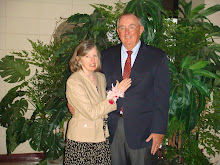
Don and me at the Makhtesh.


Monday, June 21, 2010

June 21


Today is a relatively easy day. Tests and lectures in the morning and free the remainder of the day.

Tomorrow we leave for a three day two night trip west and south through the Negev, visit some archeological sites and back to the east to stay overnight in a hostel in Arad.

We then visit some more archeological sites and spend the night somewhere. Then we head for Masada, the Dead Sea and En-Gedi and then home.

No wireless connection where we are going so I will update the blog when I return on June 25.

Below is a group picture from the Mount of Olives looking over the Kidron Valley to the Holy City. I asked the professor to airbrush some hair on me, but he laughed.


Sunday, June 20, 2010

June 20


Today is Sunday and an off day. I went to the Church of the Holy Sepulcher this morning.

It is the traditional site of the death, burial preparation, and tomb of Jesus. This seems to have majority agreement among the experts as to the accuracy of the site.

The church is a Greek Orthodox Church. The place is alive with icons, paintings, frescos, candles and people. It was a little hard to get into the spirit of things, but I am glad I went there.

The church service was entirely in Greek. Scripture readings, chants, and smoke were most predominant. I was completely lost as to what was going on.

Below is an example of the type of frescos in the church. From right to left, death, burial preparation and burial.


After the church service, I did my laundry in the school laundry, prepared some work for tomorrow and ate lunch. The rest of the day is set aside for rest, reading and lattes.

Happy Father's Day to all of you dads.

Saturday, June 19, 2010

June 19


We left for the Mount of Olives at 7 am and arrived there in the cool of the morning. As we looked over the Kidron Valley to Jerusalem and Mount Zion, our professor taught us on the importance ascribed to it in the Old Testament. Psalm 132 says that the Lord has chosen Zion and he repeats this often in the OT. Isaiah is fundamentally about Jerusalem from start to finish.

We also spent some time in the Garden of Geshsemene and reflected on the activities there. From this point Jesus could actually see the Roman soldiers marching toward him some time before they got there.

Below is a picture of Jerusalem (and Mt Zion) from the Mount of Olives


This is a tree from which it is supposed the "Crown of Thorns" came.


For those that have not seen an old olive tree - here is one.


Then, like yesterday, a new contrast lay ahead of us. We went into the West Bank to visit the Herodium and Bethlehem. The West Bank is largely controlled by Palestinians. However, there are numerous Jewish settlements which creates a lot of tension.

Also, the borders between Palestine and Israel are lined with either a high concrete wall or razor barbed wire.

The Herodium was a place built by King Herod (King at the time of Jesus' birth). It was a massive ornate structure placed on the top of a mound which was dug out and filled in to look even. It is located a few miles south of Bethlehem. Here is a photo from a distance.


From the top where it has been excavated:


Here is a view from above of his swimming pool - looks like it is about half the size of a football field.


Me at the Herodium.


And finally an ancient wine press chiseled out of solid rock. It was located at the top of a hill that contained an ancient grape orchard. The grapes were crushed in the low, larger depression and drained into the deeper depression. Don't even think about the sanitary (or lack thereof) conditions.


Friday, June 18, 2010

June 18


This was another day of contrasts. From the lushness of the east to the wilderness and desert of the west.

We left at 7 AM on a tour bus and headed East and saw first hand the strategic problems of armies attacking and defending the eastern side of Israel. There are very few convenient ways to get from the coast to Jerusalem and they are all easily defended.

We stopped at the Beth Shemesh Tell (a tell is an archeological site of an old city) which was the probable site of Samson's home. It was also the town where the Philistines (with the help of two milk cows) sent the Ark of Covenant after it created so many problems for the people and their god, Dagon.

We also stopped at the Gezer Tell. Gezer was one of the cities Solomon fortified to protect central Israel and an important site over the history of the land of Israel.

We then stopped at Nebi Samwil, the traditional burial site of Samuel and just south of his home at Gibeon. From this site we could see for many miles around, including Jerusalem.

Then on to Jericho, both the site that Joshua destroyed and the new Jericho. As we stood on the old site of Jericho, the temperature was 110 degrees at an elevation of about -900 feet.

The a stop at a vista of the Judean wilderness and on home. A fun filled 11 hour day!

This is me, of course, standing at the tope of an ancient cistern which held much water for Gezer.


Standing stones at Gezer - probably got the idea from Moses (twelve tribes represented).


Solomon's Gate at Gezer - a typical arrangement to protect the city.


View northeast - toward Jerusalem - from the top of Nebi Samwil.


A view of the wilderness between Jericho and Jerusalem. Very likely the same terrain Jesus and his disciples pass through several times.